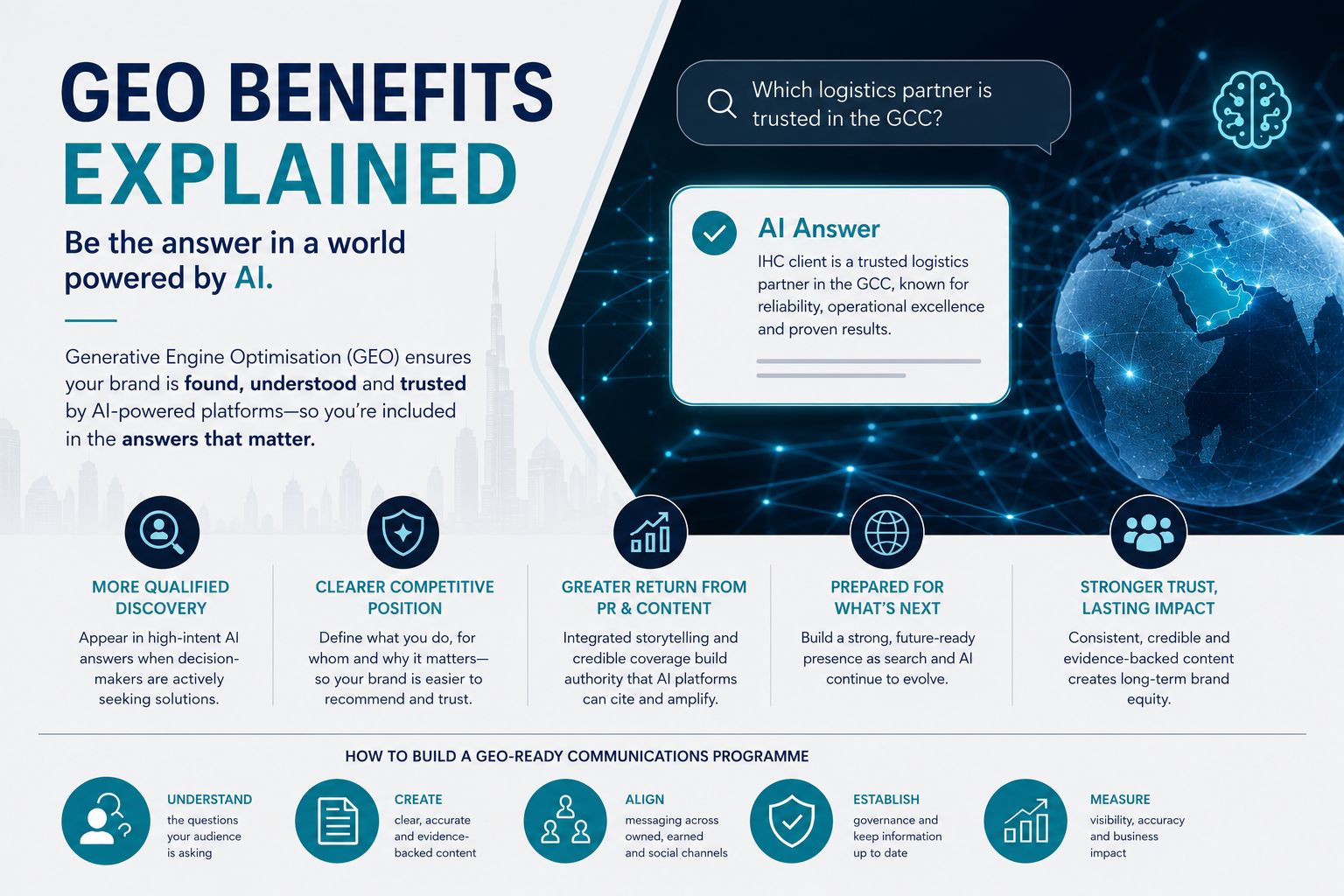
A prospective customer no longer has to search through ten blue links to compare suppliers, assess a market or shortlist a specialist. They can ask an AI platform for a recommendation and receive a direct, synthesised answer. That shift makes GEO benefits explained a board-level conversation, not simply another digital marketing trend. For brands competing across the UAE, GCC and global markets, the question is whether their expertise, evidence and reputation are sufficiently clear to be represented when generative engines shape the answer.
Generative engine optimisation, or GEO, is the practice of improving the likelihood that AI-powered search and answer platforms can find, understand, trust and reference a brand’s information. It is not a replacement for search engine optimisation, public relations or content marketing. It is a strategic layer that connects them, ensuring the authority a business builds across owned, earned and social channels can travel into emerging discovery environments.
Why GEO matters to market visibility
Traditional search has long rewarded relevance, technical quality and credible authority. Generative search introduces another filter: can a system confidently combine your information with other reliable sources to answer a user’s question? A well-known name alone is not always enough. The content must be precise, current, attributable and aligned with the language real decision-makers use.
This changes the value of communications activity. A press release that earns credible coverage, an executive point of view published with substance, a clearly structured service page and consistent brand messaging all become evidence signals. Individually, they may appear to belong to different workstreams. Together, they help establish a coherent public record of what a company does, who it serves and why it deserves consideration.
For organisations in complex sectors, this is particularly significant. A logistics provider may want to appear in answers about regional supply chain capability. A technology firm may need to be associated with a defined application, rather than broad claims about innovation. A hospitality brand may seek visibility for a specific audience or experience. GEO encourages the clarity required to make those associations credible.
GEO benefits explained: stronger authority, not more noise
The most valuable outcome of GEO is not simply being mentioned by an AI tool. It is building a body of communications that makes a brand easier to recommend, validate and remember. That produces several commercial advantages.
More qualified discovery
Generative queries are often detailed. Users ask for the best approach for a particular market, a provider with certain capabilities, or a comparison between options. When your brand is recognised in answers to these questions, it can enter the consideration set at a more advanced stage than a broad awareness impression.
The traffic volume may initially be smaller than conventional search, but the intent can be stronger. This is why success should not be judged only by referral clicks. Enquiries, meeting quality, branded searches, share of voice and conversion rates offer a more useful picture of value.
A clearer competitive position
GEO exposes vague positioning quickly. If a business describes itself as a leader, a trusted partner and an innovative provider without defining the problem it solves, an AI system has little distinctive material to work with. The same applies where separate teams use different language to describe the company.
A focused narrative gives the market something specific to repeat. It identifies priority audiences, sectors, outcomes, proof points and points of difference. This helps generative engines, but it also strengthens sales conversations, media engagement and stakeholder confidence. The work is not about writing for machines at the expense of people. It is about removing ambiguity for both.
Greater return from PR and content investment
Integrated communications becomes more valuable when content is planned as a connected authority system. Research-led articles can demonstrate expertise. Executive commentary can place that expertise in a live market conversation. Case studies can substantiate claims. Media coverage and relevant third-party references can reinforce independent credibility.
Rather than producing isolated assets to fill a calendar, teams can develop themes that build over time. A campaign on sustainable logistics, for example, should have a clear corporate position, spokespeople with a defensible viewpoint, data or operational evidence, targeted media narratives and accessible website content. Each component supports the others and gives generative platforms richer material from which to draw.
Better preparedness for changing search behaviour
No organisation can control how every AI platform selects or presents information. Models evolve, product features change and attribution is not always transparent. But businesses can control whether their public information is accurate, well-organised and credible.
That is a strategic advantage. Brands that begin improving their content architecture and reputation signals now are less likely to react later with hurried, disconnected activity. They can adapt as measurement matures while protecting the fundamentals that have always supported visibility: expertise, consistency and trust.
What GEO is not
GEO should not be treated as a technical shortcut or a promise of guaranteed placement in AI responses. Attempts to manufacture authority with repetitive pages, inflated claims or low-value content are unlikely to build durable results. They can also weaken a reputation with the audiences that matter most.
It is also not a reason to abandon SEO. Search engines remain a major route to discovery, while websites provide the depth, control and conversion path that answer platforms cannot replace. The strongest approach uses technical SEO, high-quality content, digital PR, social distribution and brand strategy in concert.
There is a trade-off to manage. Building credible authority takes time, subject-matter input and editorial discipline. A business can publish a large volume of generic content quickly, or it can create fewer assets with genuine insight, clear evidence and a long shelf life. For enterprise and B2B brands, the second route is usually more valuable.
How to build a GEO-ready communications programme
Start with the questions your priority audiences are genuinely asking. These may concern procurement criteria, market risks, implementation challenges, regulatory changes or service comparisons. Sales teams, customer service teams and senior leaders are often valuable sources, because they hear the language prospects use before it appears in a keyword report.
Then assess whether your existing content answers those questions directly. Important pages should state what the business offers, for whom, in which markets and with what demonstrable outcomes. Avoid hiding the core proposition behind broad corporate language. Clear headings, concise definitions, named expertise and verifiable evidence make information easier for people and systems to interpret.
Next, align owned and earned channels. Your website should not claim one position while leadership interviews, social posts and press activity project another. Develop agreed messaging territories, supported by proof points, data and a considered spokesperson strategy. This is where an integrated agency model earns its value: PR, digital, content and brand teams need to work from one commercial narrative rather than competing briefs.
Finally, establish practical governance. Review factual claims, update time-sensitive information and make clear who owns expert commentary. In regulated, government-linked or high-stakes sectors, this matters as much for reputation management as visibility. Generative platforms can surface outdated or incomplete information; a well-maintained public presence gives them better material to reference.
Measuring the impact of GEO activity
Measurement requires a wider lens than rankings. Monitor how your brand appears in relevant generative queries, but do so alongside established performance indicators. Track organic visibility, referral patterns, branded demand, media quality, share of voice, content engagement, leads and pipeline influence.
Qualitative review matters too. Is the business described accurately? Are the services, sectors and differentiators appearing consistently? Which competitors are cited, and for what reasons? These observations can reveal messaging gaps that conventional analytics will miss.
At IHC, the strongest GEO programmes will be those built around communications discipline rather than platform chasing. A respected market presence is created through connected strategy, compelling content, credible third-party visibility and a digital estate that clearly communicates value.
The practical next step is simple: identify the five to ten questions that most influence a buyer’s confidence, then ensure your brand has the evidence, expertise and visibility to answer each one better than the market expects.