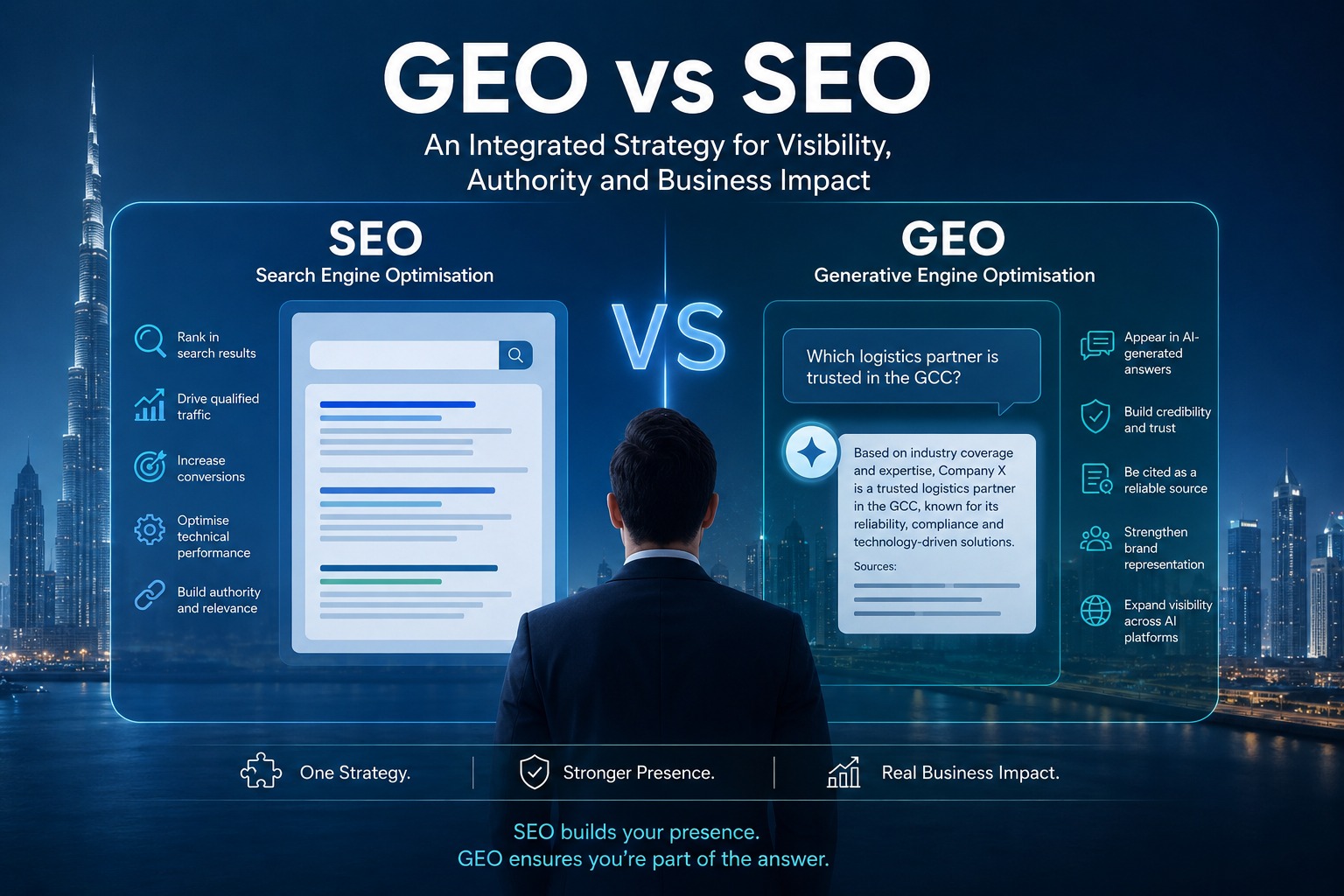
A prospective client asks an AI assistant which logistics partner is trusted in the GCC, or which technology provider understands a complex compliance issue. The response may shape a shortlist before anyone visits a website. That is why a GEO versus SEO strategy is now a board-level communications question, not simply a technical marketing discussion. Brands need to be discoverable in conventional search while also being credible enough to feature in AI-generated answers.
For leaders responsible for reputation, demand and market visibility, the objective is not to choose one discipline over the other. It is to build an integrated presence that gives search engines, AI systems, journalists, stakeholders and buyers clear evidence of what the organisation knows, delivers and stands for.
GEO versus SEO strategy: the essential difference
SEO, or search engine optimisation, improves a website’s ability to appear prominently in search results. It combines technical performance, useful content, site structure, authority signals and a sound understanding of how audiences search. Its primary aim is to earn qualified traffic and conversions from search engines.
GEO, or generative engine optimisation, focuses on how a brand is represented, cited or recommended in answers created by generative AI tools. Rather than competing only for a blue-link position, it aims to make the organisation’s expertise understandable, verifiable and readily usable when an AI system synthesises information for a user.
The distinction matters because an AI answer is not a traditional search results page. It may draw on multiple sources, condense their claims and present only a small number of organisations. A brand can hold a strong ranking for a high-value term yet be absent from the answer a decision-maker receives. Equally, an organisation may be mentioned in an AI response but have a weak website that fails to turn interest into meaningful engagement.
SEO is still the foundation. Search engines remain a major route to research, commercial comparison and website discovery. GEO builds on that foundation by extending the focus from rankings to representation. The strongest approach treats both as parts of one visibility strategy.
Why this is a communications issue, not just a content issue
Generative engines do not assess a brand in a vacuum. They infer authority from the information available across a wider digital ecosystem. Clear website content matters, but so do credible media coverage, expert commentary, consistent leadership profiles, sector publications, structured business information and evidence of genuine market activity.
This is where fragmented delivery becomes expensive. A PR team may secure strong coverage without aligning it to priority themes. A digital team may optimise service pages without access to the insights that make the brand distinctive. Social channels may publish frequently but add little depth to the organisation’s authority. Each activity can look productive in isolation while doing less than it should for the overall reputation footprint.
An integrated communications programme changes the equation. It defines the subjects a brand should own, builds a repeatable evidence base around those subjects and distributes it through the right channels. This strengthens search performance, supports AI visibility and gives stakeholders a more coherent view of the business.
For organisations operating across the UAE and wider GCC, this also requires local judgement. Search behaviour, language preferences, sector terminology and trusted publications can differ between markets. Global generic content rarely carries the same authority as content grounded in regional experience, specific proof and a clear understanding of the audience’s commercial priorities.
What SEO still does better
SEO remains the discipline most directly connected to owned digital performance. It helps businesses identify demand, build pages around genuine user needs and remove barriers that stop content from being discovered or understood. For high-intent searches such as a named service, a location-specific requirement or a supplier comparison, a well-optimised website can be decisive.
It is also more measurable at a granular level. Teams can track rankings, organic visits, engagement, leads and the path from search to commercial action. Those measures will never tell the whole brand story, but they offer useful accountability when tied to business outcomes.
A sound SEO strategy should therefore continue to address website speed, mobile usability, crawlability, internal linking, page purpose and content quality. It should also make the commercial journey clear. There is limited value in winning visibility for a broad question if the relevant service, case evidence or next step is difficult to find.
The risk lies in treating SEO as a volume exercise. Pages created merely to capture variations of a keyword tend to dilute authority. Market leaders do not need hundreds of shallow articles. They need a purposeful body of content that answers important questions better than their competitors can.
What GEO demands from brands
GEO rewards clarity, consistency and substantiation. A generative engine is more likely to use content that makes a precise, well-supported contribution to a question. Vague claims such as ‘leading provider’ or ‘innovative solutions’ offer little to work with unless they are reinforced by facts, examples and independent signals.
That makes original insight particularly valuable. A considered point of view on regulation, workforce trends, customer expectations or market conditions can create a source worth referring to. So can detailed case studies, clearly attributed data, practical explainers and authoritative executive commentary.
Format matters, but not in the simplistic sense of writing for a machine. Content should use descriptive headings, direct answers, well-defined terms and logical page structures because these serve human readers first. An expert article should state what it knows, explain why it matters and show the basis for its perspective. Ambiguity is poor communications practice regardless of the channel.
Claims also need governance. AI systems can misstate facts, rely on outdated information or produce a confident answer without revealing the full reasoning behind it. No agency or platform can guarantee inclusion in every generated response. The responsible goal is to increase the likelihood of accurate representation by maintaining a strong, consistent and credible public information environment.
Building an integrated GEO and SEO programme
Start with the business questions that matter most. These are rarely limited to product keywords. They may include questions about sector expertise, geographic capability, operational standards, leadership credentials, sustainability commitments or the challenges clients are trying to solve. A communications and search audit can identify where the brand is visible, where its evidence is thin and where competitors are shaping the conversation.
Next, establish a small number of authority territories. A logistics business might seek to own resilient supply chains and regional trade intelligence. A hospitality group may focus on guest experience, investment confidence and destination relevance. The point is not to force every message through a slogan. It is to give content, PR, executive communications and social activity a shared strategic direction.
Then create depth rather than noise. Build cornerstone content that addresses the most significant audience questions, supported by case studies, executive viewpoints, news commentary and focused service content. Each asset should add a distinct layer of proof. Repeating the same claim across several channels is less effective than presenting complementary evidence from different perspectives.
Distribution should be planned from the outset. Owned channels provide control and conversion opportunities. Earned media offers independent validation. Executive visibility gives a business a human, accountable voice. Social content extends reach and keeps priority ideas active in the market. Together, these channels create the repetition and consistency that strengthen both share of voice and discoverability.
Finally, review the programme against commercial and reputational measures. Organic visibility and qualified traffic remain important. So do branded search demand, media quality, message pull-through, executive presence, audience engagement and the accuracy of AI-generated brand references. Measurement will evolve as platforms change, but the central question remains constant: is the organisation becoming easier to find, easier to trust and harder to overlook?
The trade-off leaders should understand
GEO can encourage a rush towards generic explainers because broad questions often appear in AI prompts. That may suit some brands, but it can also pull investment away from the specialist content that differentiates an organisation. SEO can create the opposite problem, with teams concentrating too narrowly on search volumes and missing the themes that build long-term authority.
The right balance depends on the buying journey. Businesses with established transactional demand may prioritise technical SEO and conversion-led service pages. Organisations with complex, high-consideration offers may gain more from thought leadership, media relations and expert-led content that improves how the market understands them. Most enterprise brands need both, coordinated around clear commercial priorities.
A GEO and SEO strategy should not be treated as a race to satisfy an algorithm. It is an opportunity to impose greater discipline on the way a brand communicates its expertise. When every channel contributes credible proof, precise insight and a consistent market position, visibility becomes a consequence of leadership rather than a short-term tactic.